• 1
  • 2
  • 3
  • 4
  • 5
  • 6
  • 7
  • 8
  • 9

JOURNAL


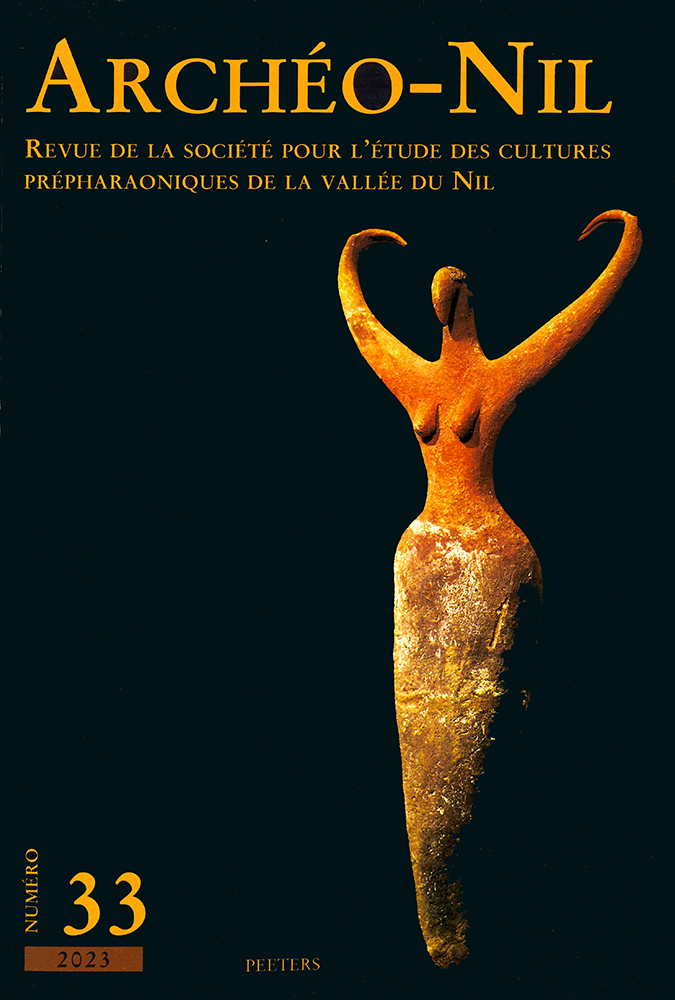
CouvAN33.png

Tables of content (by volumes)

Tables of content (by authors)

Purchase the journal

Publish in the journal

Archéo-Nil articles are now available on Persée using the links above or directly on the Persée platform

persee.fr

Founded in 1990 by Béatrix Midant-Reynes, Archéo-Nil journal is devoted to the prehistory and protohistory of the Nile valley.

Its fields of interest cover a very broad chronology, from the first Neolithic communities to the emergence of complex societies, in an equally wide geographical area, from the Mediterranean to the sources of the Nile, and in the peripheral desert regions.

It lies at the crossroads of various disciplines such as prehistory, Egyptology, archaeology, anthropology and ethnology. Archéo-Nil is a journal intended for specialists but is also intended for the exchange of ideas between the actors of the different disciplines concerned and a much wider public.

Each year, Archéo-Nil publishes an issue, often with a thematic focus, containing summary articles, information notes, reviews of scientific works or conferences, as well as a bibliography of recently published volumes and articles. The contributions are written in French and English by international specialists.

The journal is available in all libraries and research centres related to the world of Egyptology and Near Eastern prehistory. The editorial board of the journal is assisted by a scientific committee of internationally renowned Egyptologists, prehistorians and archaeologists.

.


For any information about the journal, please feel free to contact us at this address:  Cette adresse e-mail est protégée contre les robots spammeurs. Vous devez activer le JavaScript pour la visualiser.
EDITOR

Archéo-Nil, Collège de France, 11 Place Marcelin Berthelot, 75231 Paris

Publication director

Béatrix Midant-Reynes (CNRS, UMR 5608, Toulouse, France)

Chief editor 

Yann Tristant (KU Leuven, Leuven, Belgium)

Deputy editor

Dorian Vanulle (Musée du Malgré-Tout, Treignes, Belgium)

Scientific comittee

John Baines (University of Oxford, Oxford, Royaume Uni)

Laurent Bavay (Université libre de Bruxelles, Bruxelles, Belgique)

Charles Bonnet (Institut de France, Paris, France)

Nathalie Buchez (INRAP, Amiens, France)

Isabella Caneva (Università del Salento, Lecce)

Josep Cervelló Autuori (Universitat Autònoma de Barcelona, Barcelone, Espagne)

Laurent Coulon (Institut français d’archéologie orientale, Le Caire, Égypte)

Éric Crubézy (UMR 5288, Université Toulouse 3, Toulouse, France)

Marc Étienne (Musée du Louvre, Paris, France)

Renée Friedman (University of Oxford, Oxford, Royaume Uni)

Maria Gatto (The Aswan-Kom Ombo Archaeological Project – AKAP)

Nicolas Grimal (Institut de France, Paris, France)

Ulrich Hartung (Institut archéologique allemand du Caire, Le Caire, Égypte)

Christiana Köhler (Universität Wien, Vienne, Autriche)

Bernard Mathieu (UMR 5140, Université Paul Valéry, Montpellier 3, CNRS, Montpellier, France)

Dimitri Meeks (UMR 8546, CNRS PSL, Paris, France)

Catherine Perlès (UMR 7055, Université Paris Nanterre, CNRS, Nanterre, France)

Pierre Tallet (Université Paris Sorbonne, Paris, France)

Dominique Valbelle (Sorbonne Université, Paris, France)

Pierre Vermeersch (KU Leuven, Leuven, Belgique)

Pascal Vernus (École Pratique des Hautes Études, Paris, France)


PUBLISHER

Peeters, Bondgenotenlaan 153, B-3000 Leuven, Belgique
Cette adresse e-mail est protégée contre les robots spammeurs. Vous devez activer le JavaScript pour la visualiser.


News

AGM 2026

Our next Annual General Meeting will take place on Monday 22 January 2026 at 6:00 pm at the École du Louvre, Palais du Louvre, Place du Carroussel, Porte Jaujard, Paris 1er (métro Palais-Royal/Musée du Louvre, lines 1 and 7).

It will be followed by the lecture (in French) of Nathalie Buchez (INRAP Hauts-de-France, UMR 5608 TRACES) and Samuel Guérin (Inrap Hauts-de-France, UMR 8164 HALMA)


Tell el-Iswid et les sociétés prédynastiques deltaïques : de la culture de Basse-Égypte à l’unification politique

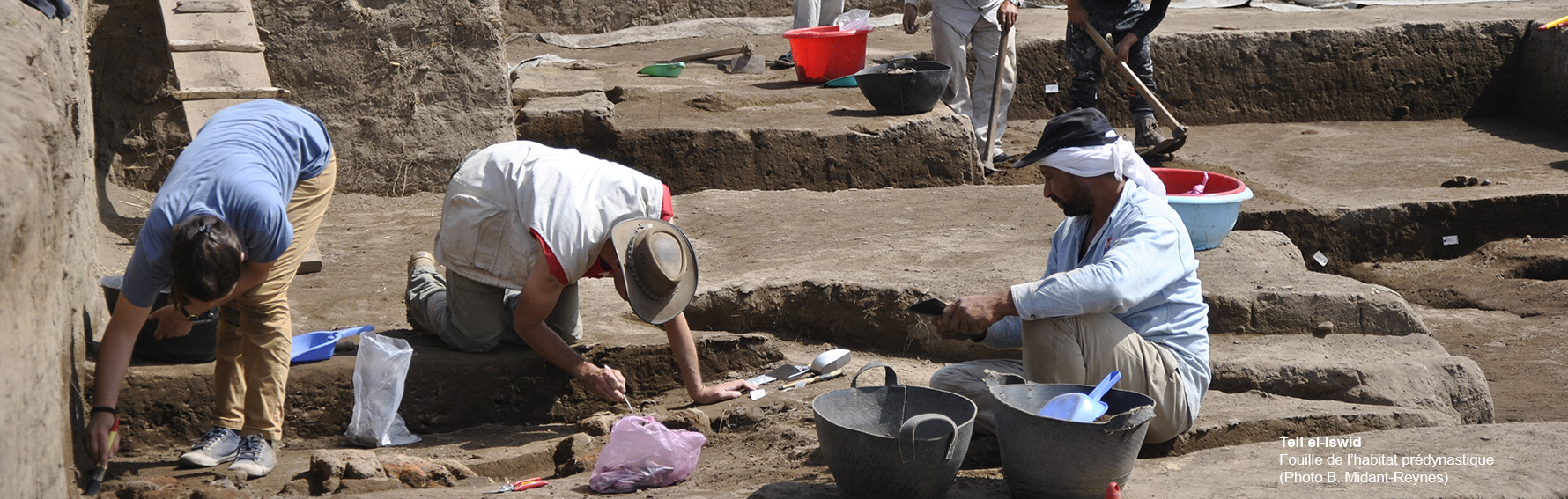
 Le Tell d’Iswid localisé dans le delta oriental est le fait d’une occupation continue entre 3800 BCE et 3100 BCE. Il offre l’opportunité d’étudier, du point de vue des communautés du nord, de Basse-Égypte, longtemps restées dans l’ombre par rapport à celles du sud, de Moyenne/Haute-Égypte, les évolutions majeures qui s’opèrent au cours au IVe millénaire pour déboucher en fin de millénaire sur une monarchie et une culture unifiée.

Le techno-complexe de Basse-Égypte (ou de culture Bouto) semble se démarquer du Néolithique local et suivre une trajectoire évolutive propre, marquée par une forme de spécialisation et par là même de complexification sociale, jusque 3400/3300 BC et les bouleversements qui découlent du développement des contacts avec la Moyenne/Haute-Égypte.

On aborde alors l’une des questions parmi les plus largement débattues et qui a trait aux processus de formation de l’Égypte pharaonique : l’homogénéisation culturelle de la fin du IVe millénaire qui d’après nos travaux serait directement liées à l’unification politique et aux changement drastiques du système de production qui l’accompagne.


Tell el-Iswid and the Predynastic Deltaic Societies: From Lower Egyptian Culture to Political Unification

 The site of Tell el-Iswid, located in the eastern Nile Delta, exhibits continuous occupation from 3800 to 3100 BCE. It provides a unique opportunity to study—from the perspective of the northern communities of Lower Egypt, long overshadowed by those of the south (Middle/Upper Egypt)—the major transformations that took place during the 4th millennium BCE, culminating at the end of the millennium in a unified monarchy and culture.

The Lower Egyptian techno-complex (or Buto culture) appears to diverge from the local Neolithic and follow its own evolutionary trajectory, characterized by increasing specialization and, consequently, social complexity, up to 3400/3300 BCE. This period marks a turning point, as profound changes arose from the intensification of contacts with Middle/Upper Egypt.

This leads to one of the most hotly debated questions concerning the formation of pharaonic Egypt: the cultural homogenization of the late 4th millennium BCE, which, according to recent research, is directly linked to political unification and the drastic changes in production systems that accompanied it.


News


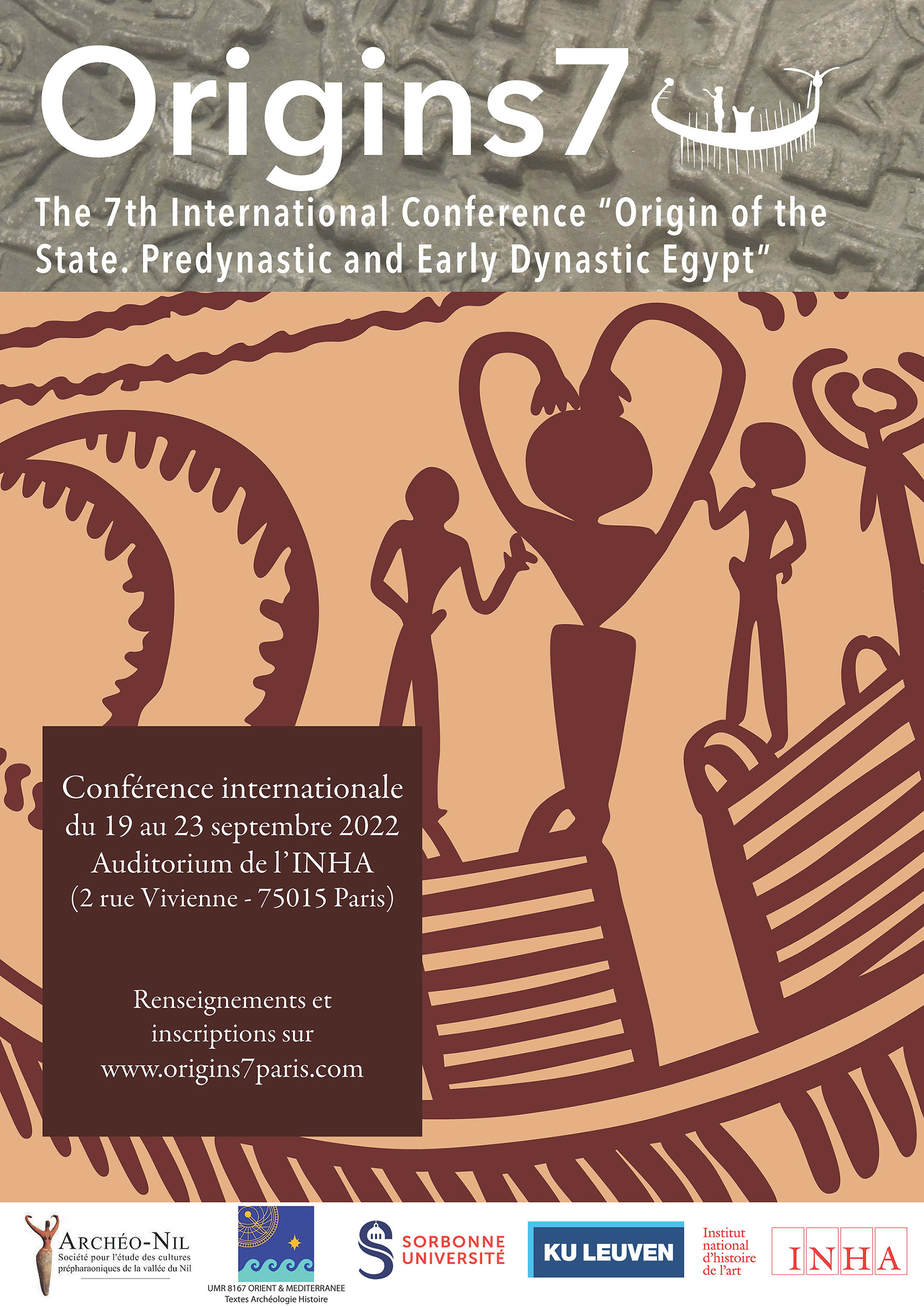
Affiche Origins7

Origins7 Conference in Paris!

19-23 September 2022

Paris hosted the 7th edition of the Origins international conference dedicated to the study of Predynastic and Early Dynastic cultures of the Nile Valley. For five days, specialists in the field will present their work and discuss the most recent results. Archéo-Nil is a partner of the event.

For more information: www.origins7paris.com


News

 25/06/2021

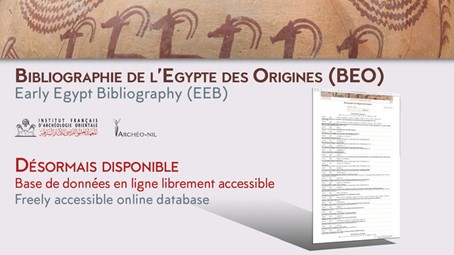
Early Egypt Bibliography (EEB)

BEO


For over 25 years, the “Bibliography of the Prehistory and the Early Dynastic period of Egypt and northern Sudan” has been the essential bibliographical research tool regarding the Prehistoric, Predynastic and Early Dynastic periods in Egypt and northern Sudan (up to the latitude of Khartoum). The original bibliography was published in 1995 by Stan Hendrickx, with yearly updates in the journal Archéo-Nil, from 2010 onwards in collaboration with Wouter Claes. With the generous aid and collaboration of the IFAO (Christian Gaubert) and Archéo-Nil (Yann Tristant), the EEB is now available as a freely accessible and online database at

https://www.ifao.egnet.net/bases/beo/

News

05/05/2022

persee.fr

Archéo-Nil is now available open access on Persée!

Our journal is now available open access on the website Persée nd includes the volumes from 1990 until 2021. Each article has a doi and keyword search is now possible. You can find them from the Journal tab or directlty on Persée website.

More articles will be available soon. Happy reading!


More


Contact

Archéo-Nil

Archéo-Nil

Archéo-Nil is a non-profit society created in 1990 to promote the study of the pre-pharaonic cultures of the Nile valley (newsletters, conferences, exhibitions, conferences, etc.) and to assist associated research and archaeological expeditions.”Archéo-Nil is a non-profit society created in 1990 to promote the study of the pre-pharaonic cultures of the Nile valley (newsletters, conferences, exhibitions, conferences, etc.) and to assist associated research and archaeological expeditions.


Archéo-Nil

Collège de France

11 Place Marcelin Berthelot

75231 Paris

France

secretariat@archeonil.fr

  Facebook   Twitter